
Cooking ahead
One of the attractions of sous vide is cooking ahead: cook food in its bag, chill it, and reheat it later in the week. Professional kitchens call this cook-chill. It can work well at home, but it adds two stages where food spends time at temperatures that matter: the cooling after cooking, and the reheating before eating. This guide covers both, along with how long food keeps in between.
The FDA Food Code, written for restaurants and other food businesses, treats sous vide and cook-chill as reduced oxygen packaging and surrounds them with controls, including fast cooling, cold holding and limits on storage time. Those controls exist because cooked food in a sealed, low-oxygen bag is not shelf-stable. A home kitchen is not covered by the Food Code, but the same principle applies: cooked food has to be cooled quickly and kept cold, and it does not keep indefinitely in the refrigerator.
Cooling quickly
The USDA Food Safety and Inspection Service (FSIS) advises refrigerating leftovers within 2 hours of cooking, and dividing large amounts into smaller portions in shallow containers so that they cool quickly in the refrigerator. Food passes back down through the danger zone, from 140°F to 40°F (60°C to 4.4°C), as it cools, and the aim is to shorten that stretch.
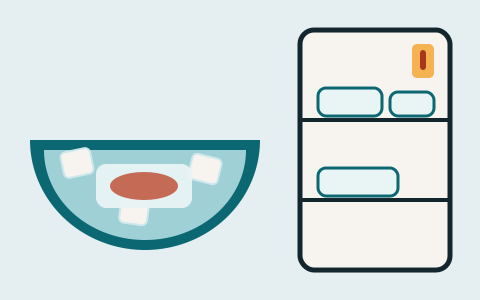
Sous vide food is already in thin, flat bags, which helps. For faster cooling, the Food Code lists methods that food businesses can use, including placing food in shallow pans, separating it into smaller or thinner portions and stirring it in a container placed in an ice water bath. For a sealed bag, the home version is straightforward: move the bag from the hot bath into a bowl or sink of ice and water, keep it submerged, and add ice as it melts. Then move it to the refrigerator.
For context, the Food Code's cooling rule for food businesses is that cooked food must go from 135°F (57.2°C) to 70°F (21.1°C) within 2 hours, and from there to 41°F (5°C) or below within a further 4 hours. That rule is written for regulated kitchens, not as consumer guidance, but it shows how much weight professionals put on the first part of cooling.
Two rules that do the work
- Into the refrigerator within 2 hours of cooking (1 hour if the room is above 90°F), per FSIS.
- Refrigerator at 40°F (4.4°C) or below, checked with an appliance thermometer.
Refrigerator storage
FSIS advises that leftovers be used within 3 to 4 days, kept in a refrigerator at 40°F (4.4°C) or below. This handbook does not give storage times for raw food, because the FSIS and FDA documents it relies on were not checked for them; check current government storage guidance for those.
Two points are easy to miss with sous vide. First, the cited FSIS guidance gives no longer storage time for food that has been vacuum-sealed at home, so this handbook treats sealed food like any other. Second, cooked food sealed in its cooking bag counts as cooked leftovers. The bag keeps it tidy; it does not make it last longer according to the cited guidance.
Listeria is the reason refrigerator time limits matter even for food that looks and smells fine. The CDC explains that Listeria infection can be especially harmful for pregnant women, newborns, adults aged 65 or older and people with weakened immune systems. If you are cooking for any of them, keep well within the limits, and when in doubt, throw it out.
Freezing
FSIS explains that food kept frozen at 0°F (-17.8°C) stays safe indefinitely, but its quality falls the longer it is stored. Freezing stops the clock on safety without improving the food, so freeze cooked food promptly, while it is well within its refrigerator time, rather than near the end of it.
Sealed cooking bags are convenient for freezing because they lie flat and keep air away from the food. Label each bag with what it is and the date it was cooked.
Thawing cooked food
The FSIS guidance on safe thawing applies to cooked food as well as raw. Thaw it in the refrigerator, in cold water in a leak-proof bag with the water changed every 30 minutes, or in the microwave. Do not thaw it on the counter. Food thawed in cold water or in a microwave should be used straight away.
Reheating to 165°F
FSIS advises reheating leftovers to 165°F (73.9°C), measured with a food thermometer. The Safe Minimum Internal Temperature Chart lists leftovers and casseroles at the same figure.
This creates a practical question for sous vide cooks who like to reheat food gently in a water bath. A bath set below 165°F cannot bring food up to 165°F, because food does not get hotter than the water around it. Reheating in a bath set lower than that falls outside the FSIS advice for leftovers. To follow it, set the bath at 165°F or above, or reheat by another method, such as a pan, oven or microwave, and check the centre with a thermometer.
Labels and a simple log
Most storage mistakes are memory mistakes. A strip of tape on each bag with the food, the date it was cooked and the date it must be eaten or frozen by takes seconds and removes the guesswork. If you cook ahead regularly, a short note on the refrigerator listing what is inside and when it was made does the same job for the whole household.
Example: a cook-ahead week
Worked example
An illustration only. It describes no real household and is not a meal plan.
- Sunday: four portions of chicken are cooked in a bath set at 165°F, and the thickest piece is checked with a thermometer.
- The bags go straight into ice water until cold, then into a refrigerator that reads 40°F or below. Each bag is labelled with "cooked Sunday".
- Two portions are moved to the freezer on Sunday night, well inside the 3 to 4 day window.
- One portion is reheated on Tuesday and one on Wednesday, each to 165°F, checked with a thermometer.
- The frozen portions are thawed in the refrigerator later and reheated to 165°F before eating.