
What sous vide means
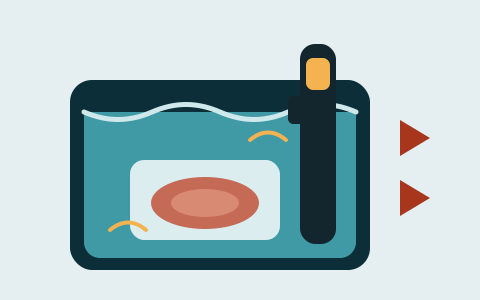
Sous vide is French for "under vacuum". In a home kitchen it describes a simple routine: food is sealed in a bag, the bag goes into a container of water, and a heating device holds that water at one chosen temperature while the food cooks. When the food is done it is either served, often after a quick sear in a hot pan, or cooled quickly and stored for later.
The method began in professional kitchens and food manufacturing, and it is still regulated as a special process there. The FDA Food Code, the model code that US states and local agencies use to write their rules for restaurants and other retail food businesses, treats sous vide as a form of reduced oxygen packaging. That label matters for home cooks too, because it points to the two things that make the method different from roasting or frying: the food sits in a sealed, low-oxygen bag, and it is often cooked at lower temperatures for longer. The food safety guide explains why both of those deserve attention.
Nothing about sous vide changes the basic food-safety rules that apply to any cooking. The USDA Food Safety and Inspection Service (FSIS) publishes safe minimum internal temperatures for meat, poultry, seafood, eggs and leftovers, and those temperatures apply whether the heat comes from an oven, a grill or a water bath.
Why a water bath behaves differently
In an oven, the air is much hotter than the temperature you want the food to reach. The outside of a roast cooks faster than the middle, and the cook has to judge when to take it out before the outer layers overcook. In a pan, the same is true at a smaller scale.
A water bath works the other way round. The water is set to the temperature you want the food to end up at, or close to it. Heat moves from the water into the bag and on into the food until the food approaches the temperature of the water. Because the water is no hotter than the target, the outside of the food does not race ahead of the middle in the same way. This is the main reason people use the method: it makes it easier to reach an even result from edge to centre.
Two practical consequences follow from that. First, the bath temperature sets the ceiling. Food in a bath held at a given temperature will not get hotter than the water, however long it stays in. So if a food needs to reach a particular safe minimum internal temperature, the bath has to be set at or above that temperature. Second, getting the middle of a thick piece of food up to the bath temperature takes time, and thicker pieces take longer. The bath does not shorten that wait; it only makes the end point easier to control.
Time and temperature work together
Cooking makes food safer by killing harmful bacteria with heat. How many are killed depends on two things together: how hot the food gets, and how long it stays there. Government guidance shows this relationship in a few places.
- Rest time. The FSIS Safe Minimum Internal Temperature Chart lists 145°F (62.8°C) for whole cuts of beef, pork, veal and lamb, followed by a rest time of 3 minutes. The rest is part of the safety instruction, not just a matter of juiciness: the temperature is held for a short period after cooking.
- Retail tables. The FDA Food Code, written for restaurants and other food businesses, includes time and temperature tables for certain whole roasts. They show that, within limits, a lower temperature held for longer can be treated as equivalent to a higher temperature held briefly. Those tables come with conditions that a regulated kitchen has to meet and document.
This relationship is the idea behind many sous vide recipes that use lower temperatures and longer times. It is a real principle, but it is not a licence to pick any combination. The safe combinations depend on the food, the bacteria of concern, the accuracy of the equipment and the thickness of the piece, and the consumer guidance this handbook relies on does not publish a list of low-temperature times for home cooks. For that reason this site gives the government's safe minimum internal temperatures as the safety figures and does not supply holding times below them.
The heating-up stretch
Every piece of food that goes into a water bath starts cold and spends some time warming up. FSIS describes the range between 40°F and 140°F (4.4°C and 60°C) as the "danger zone", where bacteria grow most rapidly. Food passes through that range on its way to any cooking temperature above 140°F, in a water bath or anywhere else.
Two things follow for sous vide. Food should go into a bath that is already at temperature, rather than being left to sit in warm water while the bath heats. And a bath set below 140°F holds the food inside the danger zone range for the whole cook, which is one reason this handbook treats those settings with care and does not give times for them. The third guide covers the danger zone in detail.
Why you still need a thermometer
It is tempting to trust the number on the heating device's display. That display tells you what the device is aiming for, measured at one point in the water. It does not tell you the temperature at the centre of the food, and it cannot tell you whether its own sensor is accurate.
FSIS advises using a food thermometer to check that food has reached a safe internal temperature, placing the probe in the thickest part of the food and away from bone, fat and gristle. Its guidance on the colour of meat and poultry makes the same point from another angle: colour is not a reliable sign that food is safe, so a thermometer is the check that counts. A separate thermometer also lets you confirm the water temperature independently, which is covered in the equipment guide.
Where this handbook stops
Sous vide recipes often give a bath temperature and a cooking time for a particular texture: a steak cooked to a given doneness, or poultry kept tender. Some of those recipes use bath temperatures below the FSIS safe minimum internal temperatures and rely on long holding times instead. This handbook does not repeat or endorse those times, because it cannot tie them to a government source written for home cooks.
That leaves a clear rule for the rest of the site. When a guide gives a safety temperature, it is a government safe minimum internal temperature. When a cook chooses a lower setting for texture, that choice falls outside the guidance described here, and the temperature and doneness guide explains what that means and who should avoid it.
Example: planning one cook
Worked example
This is an illustration, not a recipe, and describes no real kitchen. A cook wants to make two thick pork chops for dinner and serve them straight away.
- They look up fresh pork on the FSIS chart: 145°F (62.8°C) with a 3 minute rest.
- They set the bath at or above 145°F and wait until a separate thermometer agrees the water has reached it.
- They seal each chop in a bag made for cooking and lower the bags into the heated water.
- When they judge the chops are done, they check the thickest part of each one with a food thermometer and confirm it reads at least 145°F.
- They sear the chops briefly, let them rest for at least 3 minutes, and serve. Nothing is left out for long; any leftovers go into the refrigerator within 2 hours.
Notice that the example never relies on a time from a recipe to decide that the food is safe. The time is a planning estimate; the thermometer reading is the check.