
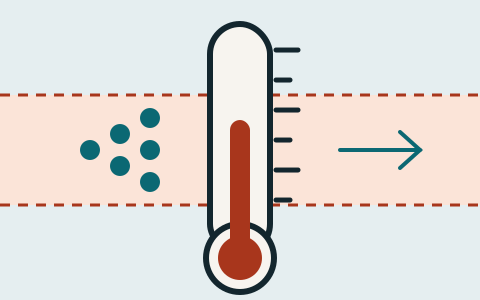
What the danger zone is
The USDA Food Safety and Inspection Service (FSIS) uses the term "danger zone" for the temperature range between 40°F and 140°F (4.4°C and 60°C). In that range, bacteria that can cause food poisoning grow most rapidly. FSIS says their numbers can double in as little as 20 minutes.
Two temperatures on either side of the range anchor everyday food safety. Cold food is kept at 40°F or below, which is why FSIS advises a refrigerator set at or below that temperature. Hot food is kept at 140°F or above. Cooking to a safe minimum internal temperature kills harmful bacteria; keeping food out of the danger zone before and after cooking stops the survivors, or new arrivals, from multiplying.
| Temperature | What FSIS guidance says about it |
|---|---|
| 140°F (60°C) and above | Keep hot food at this temperature or higher. |
| 40°F to 140°F (4.4°C to 60°C) | The danger zone: bacteria grow most rapidly, doubling in as little as 20 minutes. |
| 40°F (4.4°C) and below | Refrigerator temperature for keeping food cold. |
The two-hour limit
FSIS advises never leaving perishable food out of refrigeration for more than 2 hours. If the air temperature is above 90°F (32.2°C), as it can be outdoors in summer or in a hot car, the limit is 1 hour.
For sous vide cooks, those limits apply at both ends of a cook: to raw food waiting to be bagged and to cooked food waiting to be eaten or chilled. They also apply to the time food spends sitting in a bath that has not yet reached temperature, which is why the first guide suggests heating the water before the food goes in.
Why low-temperature cooking sits close to it
Most cooking methods move food through the danger zone quickly on the way to much higher temperatures. Sous vide is different because the bath temperature is the final temperature. When the bath is set at or above the safe minimum internal temperature for the food, the food climbs out of the danger zone and stays there, and the usual guidance applies.
Many published sous vide recipes, however, use bath temperatures below 140°F for texture reasons. A bath set below 140°F keeps the food inside the range FSIS calls the danger zone for the whole cook. Recipes that do this rely on the principle that holding food at a temperature for long enough can kill harmful bacteria, the same principle behind the time and temperature tables in the FDA Food Code. That principle is real, but the outcome depends on exact temperatures, times, thicknesses and equipment accuracy, and the consumer guidance this handbook relies on does not set out safe holding times at those temperatures for home cooks.
This handbook's position
It gives the government's safe minimum internal temperatures as the safety figures, and it does not give times for holding food below them. If you choose a lower setting for texture, you are outside the guidance described on this site.
What a sealed bag changes
Sealing food in a bag protects it from the water and keeps flavour in, but it also creates a low-oxygen space around the food. That matters because of one particular group of bacteria.
The CDC explains that botulism is a rare but serious illness caused by a toxin that attacks the nerves, and that the toxin is made by Clostridium botulinum and related bacteria. These bacteria form spores that usually do no harm when eaten, but under certain conditions the spores can grow and make toxin. The conditions the CDC lists include a low-oxygen or no-oxygen environment, low acid, low sugar, low salt, a certain temperature range and a certain amount of water. Its example is improperly home-canned, preserved or fermented food.
A vacuum-sealed bag is a low-oxygen environment. That is why the FDA Food Code treats sous vide as a form of reduced oxygen packaging and, for food businesses, attaches controls aimed at Clostridium botulinum and Listeria monocytogenes, including strict refrigeration and limits on how long the packaged food can be kept. Home kitchens are not regulated by the Food Code, but the hazard it is written around is the same one. The practical message for home cooks is simple: sealed, cooked food is not shelf-stable. It must be eaten promptly or chilled quickly and kept cold, as the storage guide describes.
People who need extra care
FoodSafety.gov identifies groups of people who are more likely to become seriously ill from food poisoning: pregnant people, older adults, young children and people with weakened immune systems. The CDC names similar groups for Listeria infection specifically: pregnant women, newborns, adults aged 65 or older and people with weakened immune systems.
If you are cooking for anyone in these groups, the safe minimum internal temperatures matter even more, and food cooked to lower temperatures for texture is best avoided. The CDC's Listeria advice also suggests that people at higher risk talk to a healthcare provider about their own risk. This handbook cannot give individual advice; a doctor or other qualified health professional can.
The four steps still apply
FoodSafety.gov's four steps to food safety are clean, separate, cook and chill. In a sous vide kitchen they look like this:
- Clean: wash hands with soap and water, and wash boards, tools and counters after raw food.
- Separate: keep raw meat, poultry, seafood and their juices away from ready-to-eat food, including when filling and opening bags.
- Cook: reach the safe minimum internal temperature, checked with a food thermometer.
- Chill: refrigerate promptly, within the 2 hour limit, at 40°F or below.
What this guide does not say
It does not say that sous vide is unsafe. Cooked to the safe minimum internal temperature and handled with the usual care, food cooked in a water bath is covered by the same guidance as any other cooked food. It also does not say how long any food can be held at a temperature below those minimums, or that a particular recipe is safe. Those are questions the cited consumer guidance does not answer with numbers, and this handbook does not fill the gap with guesses.
If someone becomes unwell
Food poisoning can be serious. The CDC describes botulism as a medical emergency and advises seeing a doctor or going to the emergency room immediately if its signs appear. For any suspected food poisoning, especially in someone in a higher-risk group, contact a doctor or other qualified health professional rather than relying on a website.
Next: Cooking temperatures and doneness are different questions